
Statement by Foreign Minister Mr Khanal at the Annual Ministerial Meeting of the Foreign Ministers of the Least Developed Countries
24 September 2026, New York
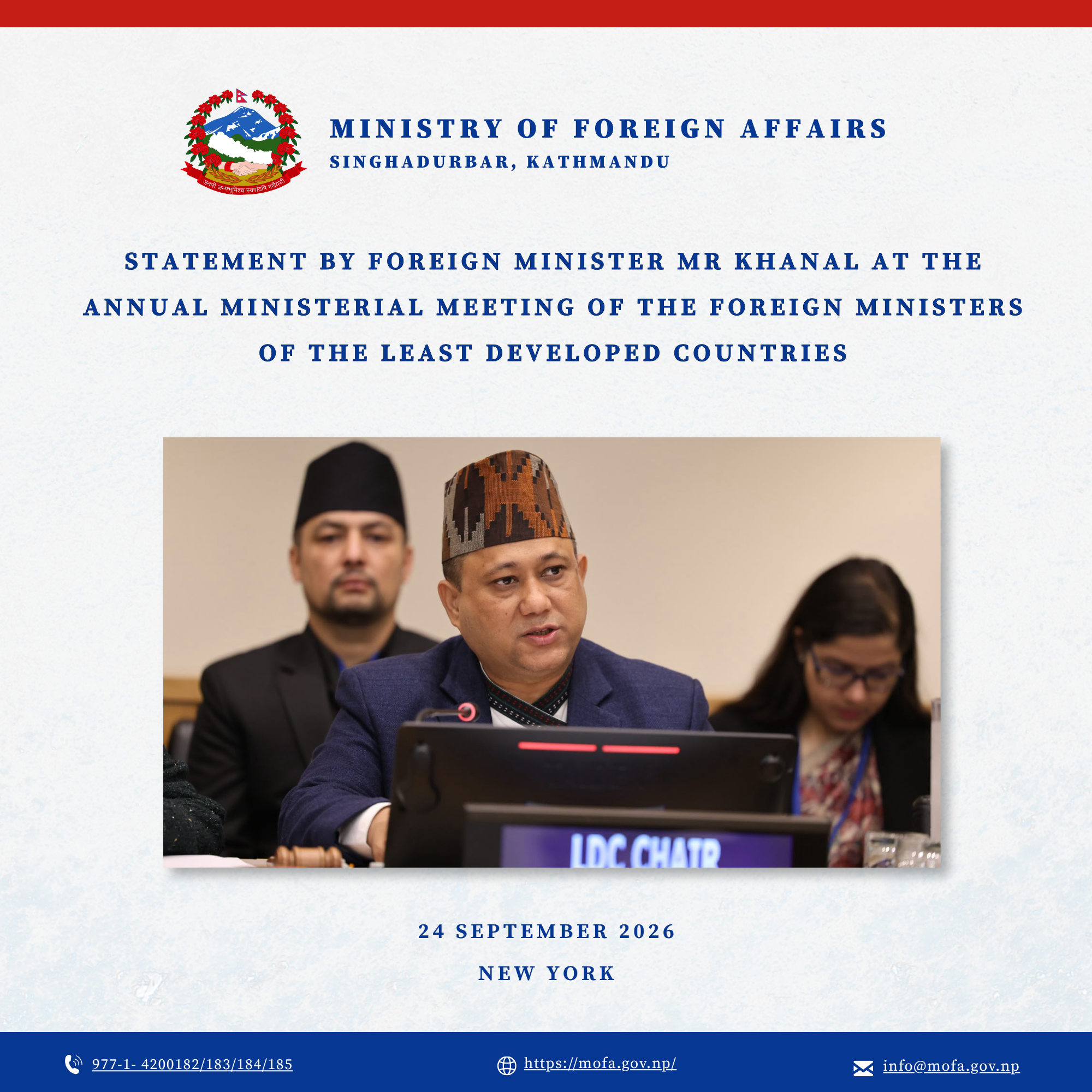
Statement by Honorable Mr. Shisir Khanal, Minister for Foreign Affairs of Nepal and outgoing Chair of the Global Coordination Bureau of the Least Developed Countries at the Annual Ministerial Meeting of the Foreign Ministers of the Least Developed Countries
From Commitments to Impact:
Fast-Tracking DPoA Implementation and Graduation Progress in the Least Developed Countries
Honorable Ministers
Under Secretary General Ms. Rabab Fatima
Excellencies,
Distinguished Delegates.
I warmly welcome you all to the Annual Ministerial Meeting of the Least Developed Countries.
Before we commence our formal deliberations, I request a solemn moment of reflection. Just weeks ago, catastrophic flash floods and debris flows tore through the trans-Himalayan corridors of Nepal, including the Bhote Koshi basin. What struck our communities was a Himalayan Tsunami—a sudden, high-altitude glacial and rock collapse that released an enormous, sediment-heavy wall of water hurtling down steep river gorges. In minutes, roaring floodwaters claimed precious lives, severed critical trade arteries, swept away concrete bridges, and wiped out the livelihoods of entire communities.
On behalf of the Government and people of Nepal, I express profound grief for the lives lost and heartfelt condolences to the bereaved families. This tragedy is not an isolated mountain hazard; it is a harrowing manifestation of the disproportionate climate risks that imperil the poorest and most vulnerable across the LDC family every day.
Excellencies,
This ministerial gathering holds profound significance for Nepal, as it marks the conclusion of our three-year tenure as Chair of the Global Coordination Bureau before we officially hand over the helm to the Republic of The Gambia.
Leading our Group through this critical juncture has been a singular honour and a monumental responsibility. On behalf of Nepal, I express our deepest gratitude to every member state for the trust, goodwill, and enduring solidarity you have extended to us throughout our stewardship.
I extend my heartfelt congratulations to the Republic of The Gambia on its election as the incoming Chair of the LDC Group. I also warmly congratulate Angola, Bangladesh, Cambodia, and Sudan on their election to the Bureau for the 2026–2029 term. To the outgoing members of the Bureau, I offer our heartfelt appreciation for your tireless collaboration, institutional wisdom, and dedication in defending our collective interests.
Our deepest gratitude goes to Under-Secretary-General Rabab Fatima and her exceptional team at UN-OHRLLS. Madam Under-Secretary-General, your steadfast advocacy and visionary leadership mobilized world leaders, multilateral banks, and the private sector to deliver the landmark outcome of LDC5 in Doha. Throughout Nepal’s chairmanship, your partnership has been a vital pillar of strength. As you transition to your new high responsibility as the Secretary-General’s Special Representative for Afghanistan and Head of UNAMA, we extend our warmest congratulations, profound appreciation, and best wishes for every success.
Excellencies,
Nepal assumed the Chairmanship during a period of acute global polycrisis. We have navigated intensifying geopolitical polarization, cascading regional conflicts, lingering post-pandemic scarring, crushing debt burdens, and an accelerating climate emergency.
Yet, this turbulent era has also showcased the unyielding solidarity of our 44 nations. Throughout our tenure, Nepal has remained guided by an absolute commitment to ensure that the LDC agenda is never marginalized in international decision-making. We placed the implementation of the Doha Programme of Action (DPoA) and its five transformative deliverables at the core of our collective diplomacy.
During the Fourth International Conference on Financing for Development (FfD4) in 2025, Nepal, alongside UN-OHRLLS, convened a dedicated LDC summit uniting heads of state, multilateral development banks, and institutional investors. Through unified advocacy, we ensured that the Compromiso de Sevilla reflected clear, LDC-specific commitments on concessional finance, expanded fiscal space, debt sustainability, and technology transfer.
Simultaneously, we have consistently championed climate justice for frontline nations. LDCs contribute negligibly to global greenhouse emissions, yet our communities bear the gravest losses. In minutes, a single climate disaster can wipe out decades of local capital. We have demanded adequate, grant-based climate finance, immediate capitalization of the Loss and Damage Fund, and universal multi-hazard early warning systems.
Crucially, Nepal has placed sustainable, irreversible graduation at the forefront of the global agenda. As a country preparing for graduation alongside several peers, we recognize that crossing economic thresholds is not an end in itself; it must be backed by productive capacity and shock resilience. We fought for the full operationalization of the Sustainable Graduation Support Facility (iGRAD), deeper integration of Smooth Transition Strategies into national planning, and extended preferential market access under initiatives like GSP+ to prevent post-graduation disruptions.
Furthermore, as Nepal concurrently served as President of the UN Economic and Social Council (ECOSOC) for the 2025–2026 session, we strategically leveraged the ECOSOC platform to amplify LDC priorities. We mobilized dedicated dialogues on reforming credit-rating methodologies, curbing illicit financial flows, establishing tax cooperation, and holding targeted engagements with the Bretton Woods institutions, UNCTAD, and the WTO.
Throughout the preparatory processes for the UN80 initiative and UN budget reviews, we sent an unequivocal message to the Fifth Committee: institutional support for LDCs, particularly through UN-OHRLLS, must be preserved and strengthened—never diluted in the name of austerity.
Excellencies,
While our collective advocacy has yielded substantial gains, an honest assessment reveals that the gap between international promises and real-world delivery remains stark. With only 36 percent of SDG targets currently on track worldwide, LDCs remain furthest behind.
The next five years will decide whether the Doha Programme of Action fulfills its promise or becomes another broken declaration. As we head into the comprehensive Midterm Review of the DPoA in March next year, we must demand a decisive structural shift from commitment to impact.
We must focus our collective resolve on four imperatives:
- Closing the Financing Gap: The international financial architecture remains outdated and inequitable. LDCs need direct debt-relief solutions, predictable grant financing, and an end to debt-servicing burdens that force vulnerable states to choose between paying foreign creditors and funding schools or hospitals.
- Building Productive and Digital Capabilities: In the era of the Fourth Industrial Revolution, we must dismantle digital and technological divides. Our economies require technology transfers, affordable digital public infrastructure, and value-chain integration to ensure our youth drive innovation rather than facing structural exclusion.
- Enforcing Real Climate Justice: Ecological recovery cannot be funded through commercial borrowing. Adaptation finance must be doubled in grants, and loss-and-damage mechanisms must deliver direct support when disasters wipe out national infrastructure.
- Securing Robust Graduation Compacts: Graduation must never feel like a punishment where critical trade preferences and development assistance are abruptly withdrawn. Graduating countries need an extended cushion of international support to build enduring economic viability.
Excellencies,
In Nepal, we are guided by this ancient ethos: Sarve Bhavantu Sukhinah—May all beings be happy, healthy, and free from suffering. True global prosperity cannot be attained when over one billion people across 44 nations remain vulnerable to systemic deprivation and environmental hazard.
It is with pride, confidence, and optimism that I formally hand over the Chairmanship of the Global Coordination Bureau of the LDCs to the incoming Chair, the Republic of The Gambia.
Under The Gambia’s stewardship, I am confident our Group will scale greater heights of unified advocacy and impact. Nepal pledges its complete, steadfast support to the incoming Chair and Bureau.
Let us remain united in purpose, assertive in diplomacy, and resolute in our shared pursuit of sustainable development, dignity, and prosperity for all our peoples.
Thank you. Namaste.
_MlbfVEdgFl_oaux7lg_YvvZnZKhlK_pq8f8ny.png.370x245_q70_crop.jpg
)