
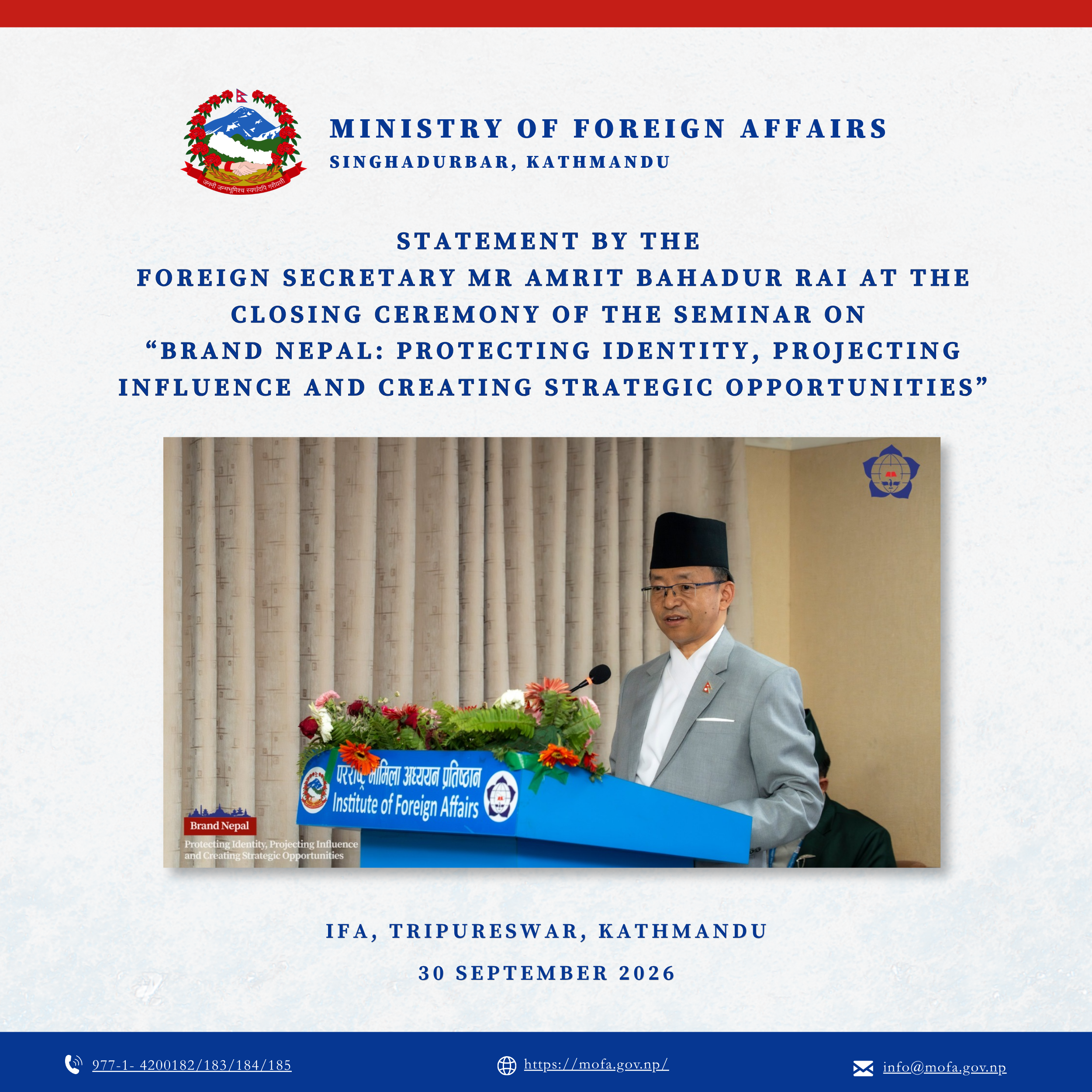
Statement by the Foreign Secretary Mr Amrit Bahadur Rai at the Closing Ceremony of the Seminar on “Brand Nepal: Protecting Identity, Projecting Influence and Creating Strategic Opportunities”
IFA, Tripureswar, Kathmandu, 30 September 2026
Statement by the Foreign Secretary
Closing Ceremony of the Seminar on “Brand Nepal: Protecting Identity, Projecting Influence and Creating Strategic Opportunities”
IFA, Tripureswar, Kathmandu, 30 September 2026
Hon. Sumnima Udas, Member of Parliament and Chair of Parliamentary
Committee on International Relations and Tourism,
Ms. Rojina Tamrakar, Executive Director of the Institute of Foreign
Affairs
Ms. Sarah Klaussner, Resident Representative of FES-Nepal
Distinguished Speakers/ Panelists
Ladies and Gentlemen
Namaskar!!! Good Evening!!!
It is my great pleasure to join you at the closing ceremony of this three-day seminar on “Brand Nepal: Protecting Identity, Projecting Influence and Creating Strategic Opportunities”.
At the outset, let me warmly thank and congratulate the Institute of Foreign Affairs, its Executive Director, the organisers, resource persons, panellists, participants and the entire team for making this important programme possible.
I greatly appreciate the time, energy, openness and intellectual engagement that everyone has brought to these discussions.
Distinguished participants,
- This is among the first programmes in Nepal to examine national branding in such a comprehensive manner. It is therefore both timely and important.
- The context in which we are having this discussion is particularly significant. Nepal has recently experienced the devastating Bhote Koshi floods, which caused a huge loss of life, damage to infrastructure and disruption to economic and social activity. Many people, including foreigners, are still missing.
Together with other disasters we have witnessed recently, this has reminded us of the growing vulnerability of our mountains, geography, rivers and communities to complex climate and environmental risks.
At the same time, it has demonstrated our resilience, community strength, preparedness and the importance of international cooperation.
- In this sense, the Bhote Koshi disaster and this seminar are closely connected. They remind us that Nepal’s international identity cannot be built only around static symbols or familiar images.
Our story must also reflect the realities we face, the knowledge we possess, the resilience we demonstrate and the contributions we can make to global conversations.
- Nepal can and should be known not only as a country of high mountains, but also as a country of mountain knowledge, climate experience, living civilisation, cultural diversity, resilience, peace and constructive international engagement.
- This is particularly relevant as the Government places economic growth and prosperity for our people at the centre of its priorities. To advance these objectives, we need to identify, strengthen and, where necessary, redefine our narratives, while making fuller use of Nepal’s considerable soft-power resources.
- Nepal already possesses a remarkable range of assets. Some are well recognised: the Himalayas and Everest, Lumbini, our living heritage, Hindu and Buddhist traditions, cultural and linguistic diversity, hospitality and adventure. Others deserve greater recognition and systematic communication: our contribution to UN peacekeeping, community forestry, traditional knowledge, Himalayan and climate knowledge, wellness traditions, creative industries, our young people, innovation, diaspora networks and emerging capabilities in science and technology.
- The task is not to replace one narrow narrative with another, but to enrich the Nepal narrative. Different audiences may enter through different doors, but those doors should lead to one coherent, credible and authentic national identity. So, there are talks about narrative architecture and coherence.
- Promoting Nepal’s soft power is consequently an important part of our foreign policy. Economic diplomacy, trade and investment, tourism, technology, education, culture, climate diplomacy and the interests of Nepali citizens abroad all depend, in different ways, on both the substance of what Nepal offers and how effectively we communicate it.
This is why the establishment of the Public Diplomacy Division at the Ministry last year is important.
It provides an institutional basis for communicating Nepal’s natural, cultural, historical and civilisational heritage and for engaging international audiences more systematically.
Some work has already begun, but the rapidly changing information environment, new technologies, including AI, and new forms of competition for attention require us to do more, with greater coordination, purpose, clarity and resources.
- Our diplomatic missions have an important role in this endeavour. They are not only our representatives; they are also listening posts, relationship-builders, opportunity connectors and platforms for presenting Nepal’s identity, capabilities and priorities.
- They can connect our tourism, trade, investment, education, culture, climate and diaspora engagements with the particular interests of different countries and audiences.
- At the same time, Brand Nepal cannot be created by the Ministry of Foreign Affairs alone. It requires a whole-of-government and whole-of-society effort involving public institutions, the private sector, academia, cultural institutions, communities, media, creative sectors, diaspora and, above all, our citizens.
- Recent international attention on Nepal provides an important context. Following the Bhote Koshi disaster, Nepal’s voice was heard prominently at the 81st session of the United Nations General Assembly.
In his address, the Prime Minister highlighted the climate dimension of the disaster and Nepal’s vulnerability despite its very low contribution to global greenhouse-gas emissions.
Nepal also used the high-level week to advance its concerns and priorities through wider international engagement.
We have a story of experience, resilience, knowledge and vision to tell the world, not just of vulnerability and victimhood.
The Foreign Minister’s extensive engagement in more than 80 important conferences, meetings and bilateral and multilateral engagements during this period has likewise provided opportunities to present Nepal’s priorities and perspectives more effectively to the international community.
These engagements create greater space for deeper relationships, stronger cooperation and tangible national benefit.
- The discussions over these three days have given us useful ideas and perspectives on how Nepal is seen by the world; how our narratives can be broadened; what new pillars of soft power can be developed; who our principal international audiences are; how messages can be tailored to tourists, investors, governments, universities, cultural institutions and the diaspora; and how our institutions and diplomatic missions can contribute more effectively.
The next step is to move from narrative to delivery, from identifying strengths to demonstrating them, from promotion to proof, and from individual initiatives to sustained national effort.
I hope the Institute of Foreign Affairs will continue to build on the insights generated by this seminar and help us translate them into practical initiatives, stronger coordination and measurable outcomes. This should not remain a one-off event, but become part of a continuing national conversation.
The Sagarmatha Sambaad in 2027 and the Yadu Nath Khanal Lecture Series, as well as MoFA Knowledge Forum, among other platforms, can provide useful spaces for continuing this conversation on Nepal’s identity, international positioning, knowledge resources and public diplomacy.
Importantly, Brand Nepal has also been reflected in the Government’s Policy and Programme for FY 2083/84 as a shared national responsibility, including through the Brand Nepal Campaign and the role of Nepali diplomatic missions abroad. We therefore have a policy basis to move from ideas towards implementation.
Distinguished participants,
Nepal possesses an extraordinary range of natural, cultural, civilisational, intellectual, human and diplomatic assets. Our task is to recognise them, protect them, communicate them effectively and, where appropriate, convert them into sustainable value and opportunity.
We should tell the authentic Nepal story more clearly, more purposefully, more confidently and more strategically.
And we must ensure that the stories we tell are reinforced by the policies, institutions, standards, products, services and experiences that people encounter.
The Ministry of Foreign Affairs will continue to strengthen public and economic diplomacy and to work with other ministries, institutions, diplomatic missions and partners to advance this agenda.
I therefore see this three-day seminar as an important beginning.
The conversations have started, new ideas have emerged, insights have been heard and we have a clearer sense of the work ahead.
Let us carry that energy forward and make Brand Nepal a continuing national endeavour, rooted in our authenticity, strengthened by our delivery, supported by all relevant institutions and stakeholders, and projected with confidence to the world.
Thank you once again to the Institute of Foreign Affairs and to everyone who contributed to making this programme a success.
Thank you.
IFA, Tripureswar, Kathmandu,
30 September 2026